- By admin
- Metal Roof Services
- 0 Comment
Why Does My Metal Roof Leak During Heavy Rain?
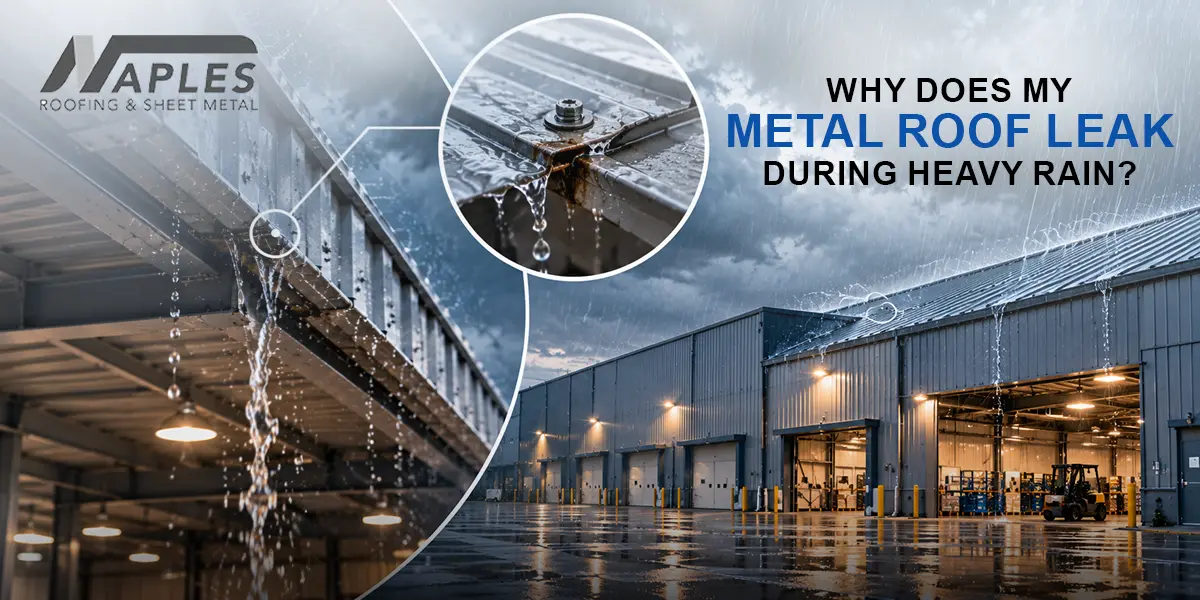
Heavy rain exposes every tiny flaw in a building. That is especially true when you assume a solid steel overhead has you covered. Standing in a warehouse during a downpour while listening to a steady drip onto concrete makes you question why an expensive setup fails. Metal stands up well against severe weather. Yet water still finds a path inside when storm clouds roll in. Most people assume the panel itself cracked. After years of crawling around industrial structures we see the issue lies in tiny movement points. Watching rain pour into your facility disrupts operations. It damages valuable inventory and creates real safety hazards for everyone inside.
Finding the exact entry point takes patience and detective work. You have to understand how metal moves under weather stress. Do not rely on quick caulk jobs or temporary spray cans. Focusing on seam integrity proper flashing and flexible coatings protects your asset for years. A proper metal roof leak repair gives you peace of mind whenever storm clouds gather overhead.
Thermal movement opens hidden gaps along roof seams
Metal expands when heat hits the surface and shrinks as temperatures drop at night. Over a couple of seasons this relentless shifting pulls fasteners loose and breaks the seal along overlapping panels. A hole smaller than a pinhead easily passes gallons of water under high wind pressure. We often see property owners slap silicone over a wet joint which fails the very next season because standard caulk lacks the flexibility to stretch with moving panels. Real durability requires specialized commercial elastomeric coatings that bond directly to the metal substrate and shift right along with it.
Fasteners back out over time
Rubber washers underneath screws dry out crack and turn brittle after exposure to UV rays. Once that seal degrades water runs straight down the shank of the screw into the deck below.
Flashing details pull away from parapet walls
Where metal meets masonry structural movement creates fine hairline splits. Water running down the vertical wall slides right behind the loose edge during severe storms.
Clogged gutter channels force water backward under panel overlaps
When rain falls faster than the drainage system can handle water pools inside the trough and backs up under the lower edge of the metal sheets. Standing water seeks any opening capillary action then pulls that trapped liquid upward between tight metal seams.
Debris buildup restricts natural drainage flow
Leaves silt and windblown trash gather in internal gutters creating tiny dams that hold moisture against vulnerable seams long after the rain stops.
Inadequate slope angle allows pooling
Low slope commercial structures often suffer from minor sagging between joists forming shallow ponds where water sits and slowly works through panel overlaps.
Panel fasteners frequently fail when UV exposure degrades their rubber washers leaving visible dark water rings around screw heads. Horizontal seams can also split as thermal expansion breaks seals over time causing moisture to drip along structural purlins. Near walls building movement pulls inverted flashing away at the joints which leads to stained drywall around ceiling edges. Finally internal gutters often clog with silt and trap backing water resulting in overflow dampness near exterior overhangs.
How we address complex metal roof leak problems in commercial buildings
When local building managers reach out to our team at naples roofing with mysterious indoor drips we rarely find a single massive hole. Instead we find dozens of tiny structural shifts across the entire surface. Managing these issues takes a methodical approach rather than quick patches. During a project for a regional distribution center in Western New York the maintenance team thought they needed a complete tear off after repeated storm damage. We evaluated the structural integrity replaced hundreds of failed fasteners with oversize capped screws and applied a reinforced liquid membrane across all open seams.
According to data from the National Roofing Contractors Association (NRCA) over 70% of low slope roof leaks occur at penetration points and flashings rather than on the flat surface of the panel itself.
Our crew managed to preserve their original infrastructure while stopping every active leak point saving the client thousands in unnecessary replacement costs. Having worked as Metal Roof Repair Contractors in Buffalo we have seen how harsh freeze thaw cycles destroy quick fixes which is why commercial properties need long term restoration strategies.
1. Perform a thorough moisture audit across seams and fasteners using thermal imaging.
2. Clear loose rust failing caulk and industrial debris from panel overlaps.
3. Replace worn neoprene fasteners with heavy duty structural screws.
4. Apply reinforced fluid applied membranes over flashing and high stress joints.
Corrosion hides beneath structural laps
Rust usually starts in places you cannot see from the top surface rusting through from the underside where condensation gets trapped between overlapping sheets.
Stack boots split from sun exposure
Pipe penetrations rely on flexible boots to seal vent pipes but constant exposure causes rubber to split open letting rain flow straight inside.
Structural settling creates unnatural stress on panel joints
Buildings settle over time shifts in the foundation put tension on the rigid steel roof deck above. That tension pulls horizontal panel laps apart creating gaps that only leak when heavy rain comes with strong winds.
Skipped maintenance schedules shorten lifespan
Small seam separations get ignored during dry months allowing wind driven rain to rot underlying insulation before anyone notices a ceiling drip.
Inferior sealant application during installation
Using cheap butyl tape during initial installation causes early seam failure as low grade materials harden and lose adhesion within just a few years.
Finding lasting solutions for persistent metal roof leak challenges
Chasing a water drop inside a large building is frustrating because water rarely drips straight down from where it entered. It runs along purlins travels down insulation craft paper and drops twenty feet away from the actual panel entry point. Working on these systems for decades shows us that temporary patches just kick the problem down the road a few months. As one of the Biggest Roofing Companies in USA networks our team at naples roofing focuses on identifying the root structural movement before applying any seal. Addressing the underlying panel movement keeps internal spaces dry when severe weather hits.